Essential food provider, climate regulator, huge genome database: The “beard” on our boat hulls leads a fascinating second life. At the very least.
High time for a closer look at the useful side of marine organisms!
The development of antifouling methods has a long history. Man versus beast is an age-old contest during which both sides keep developing increasingly more sophisticated methods to protect themselves and their interests. Indian scientist and inventor Arvind Gupta (make sure to also explore his ultra-sustainable toys from trash!) put it quite aptly once: “Biology is the most powerful technology ever developed. DNA is the software, proteins are the hardware, Cells are the factories.” In 2021 it should also be clear to most of us: No antifouling protection should risk any longer to “finish” the environment – and hence, our very subsistence base on planet earth –while keeping just a tiny part of that nature from attaching to a boat hull.
Side note: Finding that golden balance between the need for ecosystem protection and efficient antifouling at the same time is a core focus with our continuous further optimization of Finsulate.
And granted – for a long time, the need for such a sustainable balance sounded like a rather abstract demand. Or maybe even surreal, amusing. Like going overboard with excessive eco-protection values – sort of a folklorist quirk and in each case, a possible choice, among many others.
Since a comparatively short time, however, exciting new chances came up for constructive awareness raising: The fantastic beauty and finely tuned interactions of our terrestrial and marine ecosystems can now be seen, measured and above all, shown to everyone with fantastic imagery. And in an unprecedented clarity and detail.
Thanks to recent innovative cooperation between ocean and space science, among other, we now can not only take detailed pictures (often fantastic beautiful ones) and refined, long-term measurements of our ecosystems that were technically impossible before. For the first time in the development of science, anyone interested, laypeople or scientist, also has another exciting option: Anytime and from anywhere, for free, just internet connection provided, one can now watch our blue planet’s ecosystems live. Via webcams, for instance. Or by playing with via interactive maps, getting scientific data about nature and its species. Which also led to another fine practice known as crowd sourcing or citizen science: “Normal” people around the world, among which a growing crowd of sailors, can easily contribute their own nature observations and data, besides other from their own mobile devices.
The commented link collection at the end of this article gives you a first selection of fine resources – ideal for cozy autumn days! Very instructive as an interactive overview at the Encyclopedia of (here: marine) Life: Where does the species occur, what is its place in the (trophic) food chain / web, how protected is it? Recent science findings also revealed: There is a way greater diversity of marine flora and fauna than has long been assumed. Research also found that virtually all organisms perform valuable functions that far exceed the simple “eat & be eaten“ concept. Living in symbiotic communities (which science hitherto had thought of as just parasitic), they provide each other with food and essential services. Among which transport / storage of larvae, seeds, protection from predators or excessive temperatures, support with structural healing. Or other ecosystem services: sediment transport, reduction of CO2 by algae photosynthesis. In addition, those millions of species offer an immense pool of valuable genetic information. With obvious potential benefits for us humans, not only in the medical research fields.
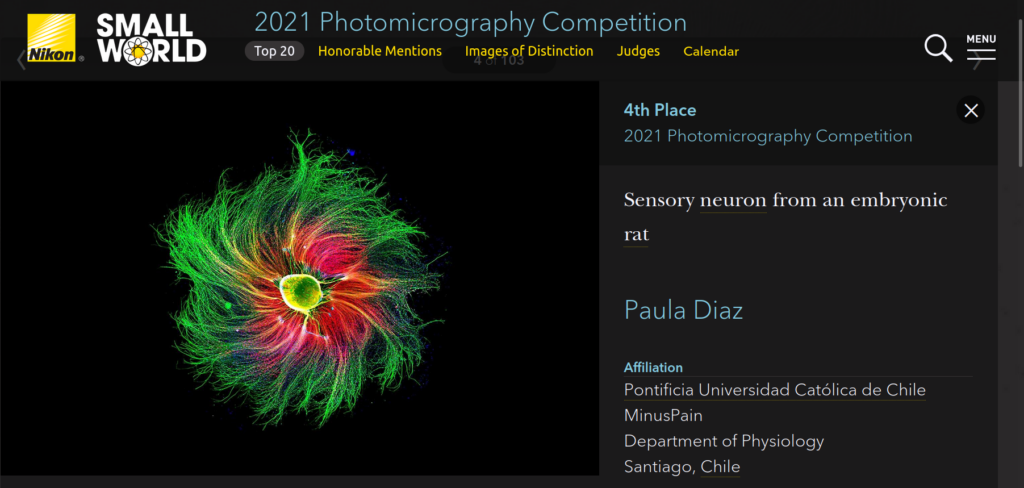
Screenshot from the great Nikons Small World gallery: Neurons of a sea anemone
Example: keyword biodiversity. In 2010, the results of a very special, large-scale science project were published: The Census of Marine Life was a ten-year collaboration of over 2700 scientists from 80 countries. Project scope: Systematic assessment and documentation of marine species and their respective population sizes. Unprecedented both in terms of cooperating partners, project duration and level of recorded details, findings revealed more than one exciting surprise. More than 1200 species were still completely unknown, for instance. Not to mention the aforesaid sophisticated communities and social interactions. Also, species were discovered in places where no one would have reckoned with their appearance, such as thriving hot spots of marine life near hydro thermal vents at the deep sea floor. Or a phenomenon which quickly became known as the white shark café, never before examined due to technical constraints.
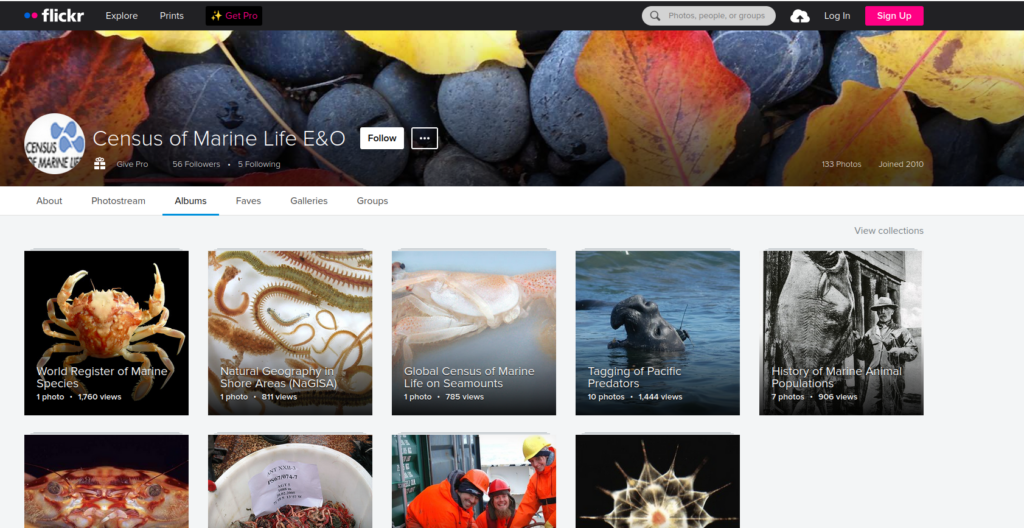
Screenshot of the magnificent Flickr photo gallery for the project: “The Census of Marine Life”.
And now, thanks to ongoing availability of the aforementioned tools and cooperation, apparently solved! Quote from the Quartz media website: “About 1,200 nautical miles east of Hawaii lies a patch of ocean that researchers had thought to be a desert of sorts. But for reasons unknown to them, each winter, great white sharks would leave the food-abundant waters along the US and Mexican west coast for a sojourn in the middle of nowhere…..this area, roughly the size of Colorado, is actually teeming with “tiny light-sensitive creatures so tantalizing that the sharks cross the sea en masse to reach them,” reports the San
Francisco Chronicle.
Quote: “The waters are also rich in squid, bigeye tuna, blue and mako sharks, and other fish….Over the years, the data collected revealed that like clockwork the great white sharks would go on an annual pilgrimage in December to this area of the Pacific that satellite imagery had suggested was barren. The tracking tags helped the expedition locate the sharks this past spring and track their movements. They also revealed unusual diving behavior that isn’t entirely understood yet. During their stay in the Pacific, the sharks kept to a surprising schedule. In the daytime, they would dive down to 1,400 feet—to an area known as the mid-water that’s on the edge of complete darkness and is populated by bio-luminescent fish—and ascend to shallower waters, around 650 feet below the surface, every night. ‘It’s the largest migration of animals on Earth—a vertical migration that’s timed with the light cycle,”
Salvador Jorgensen, expedition leader and Monterey Bay Aquarium scientist, told the Chronicle.
“During the day they go just below where there is light and at night they come up nearer the surface to warmer, more productive waters under the cover of darkness.” Read their article for more fascinating info.
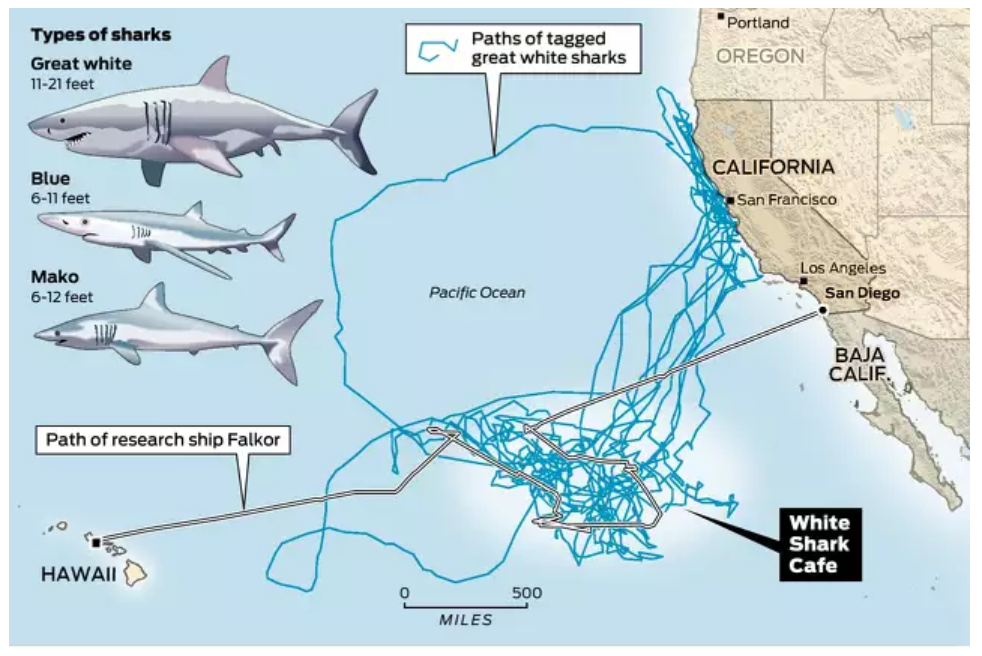
White shark cafe location. Screenshot from the San Francisco Chronicle‘s article.
Or what about the regeneration of even severely bleached coral reefs. Thanks to a tiny service provider, a fish, those corals apparently get a real chance of healing and reproduction – provided that their tiny helper fish are not decimated by our toxic human-made waste, of course. As Smithsonian Magazine reports (verbatim quote):
“One of the first signs of a sick coral reef is algae that crawls over the coral creeping over the corals and stealing their precious sunlight…..In some reefs, small fish, like this broad-billed goby (Gobiodon histrio), help eat away the algae. But how do corals make contact with fish to ask them for cleaning services? By sending out a chemical signal….reefs can only recover if surviving parts can regrow and reproduce. Clean water and healthy fish populations make recovery more likely since they help the adult coral to resist disease and the baby corals to establish themselves on the seafloor to settle.”
The interactive Marine Protection Atlas was just one of numerous follow-up projects deriving from the Census. Also worth knowing: Marine organisms attach themselves to objects in search of a stable hold in often turbulent waters. Example: Barnacles. Quote from the website of the Olive Ridley project, a sea turtle rescue center (with a great informative website all about sea turtles):
„Initially, barnacles produce larvae. These early life stages are still mobile and facilitate
further distribution. After the first six different so-called nauplius larvae, a seventh non-feeding larva develops: the cyprid. This is the stage which settles on a new substrate. The cyprid larvae has special attachment devices which allow it to hold onto the substrate, e.g. cup-shaped attachment organs on the antennae. Once settled, the barnacle develops into an adult and attaches in various ways: gripping the skin, cementing to the shell or boring into it. Adult barnacles are filter feeders, thus benefit from a constant flow of water around them. As sessile creatures they can achieve that by a) settling in an area with pronounced water movement (e.g. close to shore) or b) settling on a moving substrate such as a sea turtle.…”
The blue mussel also shows lots of creativity. Quote from this article published on the Livescience portal:
“When mussels dangle from marine surfaces, they hold on by a cluster of fine threads.These filaments may appear flimsy, but they can actually withstand powerful impacts from currents or crashing waves. Now, researchers are unraveling the secret of these thin, bungee-like cords in order to develop more effective glues and other synthetic biomedical materials. Unlike barnacles, which fasten themselves tightly to rocks or piers, mussels use silky fibers, called byssus threads, to loosely attach to a surface while still being able to drift and absorb nutrients in the water.…From laboratory tests and computer models, scientists at the Massachusetts Institute of Technology (MIT) discovered that roughly 80 percent of the length of byssus threads — the same parts of the threads that connect the mussel to a hard surface on one end — is composed of stiff material, whereas the remaining 20 percent, at the end that is affixed to the mussel itself, is soft and stretchy. The combination of these different material properties likely helps the mussels adhere to surfaces, and enables them to survive the impact of various forces….’It turns out that the …20 percent of softer, more extensible material is critical for mussel adhesion,’ Zhao Qin, a research scientist at MIT, said in a statement.”
Fact remains: As unwelcome passengers on boat hulls, too many organisms displace native species upon arrival. By attaching themselves to other organisms, eating their larvae, or simply reproducing at an alarming speed. The phenomenon is known as bioinvasion and the Invasive Species Specialist Group has an abundance of further information about it. Complete food chains in an ecosystem are thereby altered as endemic fish species, for example no longer find food. Which obviously affects their population sizes and ultimately, the fishing industry.
Conclusion. Fouling protection remains essential. But it is definitely a good idea not to use a sledgehammer just to cracking that nut. To those who still are not convinced about the latter, here is a lovely quote offering a slightly different perspective:
Nature tries everything it can to let us succeed. It is not dependent on us though – we are not the only experiment. – R. Buckminster Fuller
Links.
For your inspiration, as virtual tour, as useful interactive overviews: Biodiversity and state of ecosystems worldwide. Fair warning: Dose is the magic word. Have a break in between. As Lotus software developer Mitch Kapor once said: Getting information from the Internet is like taking a drink from a fire hydrant.
Best things first, of course. Have a seat in the front row of science: https://issdetector.com/
Follow the ISS Space Station from your mobile device – and thank Canadian astronaut Col. Chris Hadfield for being a driving force behind that fine initiative – and many other, closely related ones. Highly recommended: His Astronaut’s guide to life on earth. Brief quote from his website:
“A moustache can tell you a lot about a man. When properly administered, it can say, “this man has commanded spacecraft”, “this man escorted Soviet bombers out of Canadian airspace”, or “this man lived in a research vessel at the bottom of the ocean.” These can be tall orders to live up to – having a moustache is a big responsibility.”
Find out more about Hadfield, his inspiring modesty, dry humour and fine work here:
https://creativedestructionlab.com/mentors/chris-hadfield/
Take as many virtual dives, as long as you want, at coral reefs of your choice in 360° virtual tour. https://www.360virtualtour.co/portfolio/underwater-ocean-coral-reef-virtual-tour/
Also in this case worth to read: The fascinating tech details behind this project. Quote from the site:
“Game-changing technology has been fundamental to the success of the XL Catlin Seaview Survey. The Shallow Reef surveys were carried out using unique SVII underwater camera systems specifically developed by Underwater Earth for the project and adapted for surveying. The Deep Reef surveys were undertaken using remotely operated underwater vehicles (ROVs). The survey data was analysed post expedition using artificial intelligence and sophisticated image recognition technology.…The orb (SVII’s head) houses three SLR cameras and adapted lens allowing ultra-wide-angle photography, designed to capture full 360-degree environments. The camera system is operated by a tablet in a bespoke underwater housing using a special software developed to control the three cameras, allowing them to simultaneously take rapid-fire images every 3 seconds whilst traveling at a speed of approximately 2.5-3 km/h, powered by a military-grade underwater scooter and navigated by a diver.…The SVII images are then stitched together and published online in a fashion that allows anyone with a desktop, laptop, tablet or smartphone to self-navigate a ‘virtual dive’ in stunning high-resolution.“
Underwater cameras
A selection of these put together by the Marine Conservation Institute.
https://explore.org/livecams/oceans/channel-islands-national-park-anacapa-ocean
Note: Is one of the cameras not visible or does it have another link that is currently not working? In this case, there is often a simple but unusual reason. The webcam operators of the Farallon Islands inform us – and of course we can assume this to be valid for the other underwater webcams, too:
“Technical Difficulties? Our live webcams are installed in very wet and salty environments, and with animals that can get rambunctious at times. If you notice anything that doesn’t seem quite right with any of our webcams, please let us know by sending an email to …“
So. No whining. Allowed to observe wildlife, expect wild life.
More fantastic images, background info , interactive maps
Living Planet Index https://www.livingplanetindex.org/projects
Quote from the website: “The Living Planet Index (LPI) is a measure of the state of global biological diversity based on population trends of vertebrate species from around the world. It does this in much the same way that a stock market index tracks the value of a set of shares or a retail price index tracks the cost of a basket of consumer goods. The Living Planet Database (LPD) currently holds time-series data for over 27,000 populations of more than 4,300 mammal, bird, fish, reptile and amphibian species from around the world, which are gathered from a variety of sources such as journals, online databases and government reports. Using a method developed by ZSL and WWF, these species population trends are aggregated to produce indices of the state of biodiversity.”
Ocean biodiversity Information System: Interactive world maps of biodiversity Self-explaining:
https://obis.org/
Marine Trophic Index – about the state of fish populations worldwide. A sub projects of the Biodiversity Indicators Partnership. Can be explored by taxon:
https://www.seaaroundus.org/data/#/topic/biodiversity or by fish name: https://www.fishbase.org/
EOL, Encyklopedia of life – as the title gives away! Excellent overviews for every single type of beast, from tiny to huge: Where does it live, which place it has in the food chain and how protected is it, if at all? Why are food chains relevant, here‘s their explanation (verbatim quote again):
https://naturalhistory.si.edu/research/eol
„Food webs (aka trophic webs) illustrate the trophic (feeding) relationships in an ecological community. They are important tools for the study of biotic interactions that determine energy flows between organisms. These patterns profoundly affect species composition and richness, ecosystem stability and productivity, and the evolutionary trajectories of interacting species.“
Interaction between sea otters, sea urchins and kelp – or just another fine example for fine-tuned balances in nature: We could have become nervous about the sea otter apparently decimating Finsulate‘s special friend, the sea urchin. But it turned out once again: Wildlife is far more capable of keeping a certain healthy measure when providing for its own needs. Learn more about ecosystem balance by this interesting trio and their interactions!
Nikon Small World Exhibit – 2020 – as the name says: Great images from tiny marine species:
https://www.nikonsmallworld.com/galleries/photomicrography-competition
Concluding, let‘s not forget the highly useful role of drones serving ocean science. Here: A group of killer whales were followed from 100 ft altitude, safe for them and scientists, which allowed for new valuable insights and images. Like the website comment says: Cost-effective and non-intrusive, that method allows to monitor whale health, among other.
https://ocean.si.edu/ocean-life/marine-mammals/killer-whales-above
San Francisco Chronicle on the White Shark Cafes:
https://www.sfchronicle.com/news/article/Mysterious-great-white-shark-lair-discovered-in-13234068.php
Live Science article on mussel strength and survival smartness:
https://www.livescience.com/38375-how-mussels-cling-to-surfaces.html
Note: I had written this promotional article in 2021, to provide background and context to an innovative antifouling product for boats, yachts and industrial ships.